
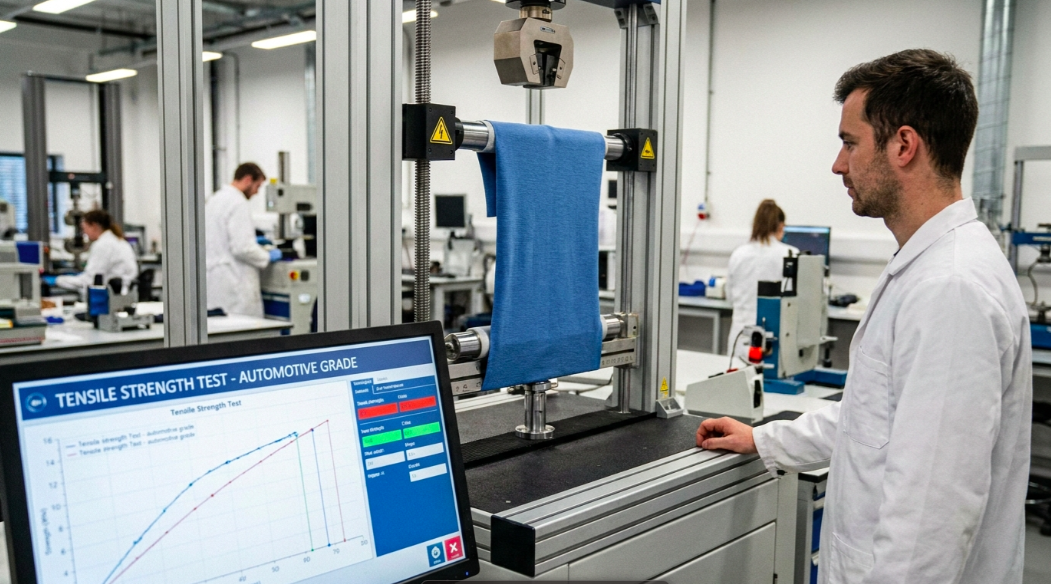
Textile Testing: Why Material Performance Standards Are Reshaping Manufacturing Competitiveness
Textile testing sits at an intersection most manufacturers overlook: regulatory compliance meets product quality meets speed to market. The companies that own textile testing infrastructure move faster, qualify materials quicker, and catch failures before costly product recalls. In automotive, medical devices, apparel, and industrial sectors, testing capability has become a competitive moat. Understanding which tests matter, which standards are rising, and how accelerated testing reshapes manufacturing timelines is essential for any company shipping textile-intensive products.
What Textile Testing Actually Covers
Textile testing is not monolithic. Different applications require different test suites because textiles perform different functions across industries.
Apparel and Fashion
- Colorfastness: Does dye persist through washing, light exposure, and perspiration? Color migration is a brand liability.
- Dimensional stability: Does the garment shrink or distort after washing? Consumer frustration drives returns.
- Fiber durability: How many wear cycles before visible degradation? Seams pulling, fabric pilling, structural failure.
- Chemical residuals: OEKO-TEX and similar standards test for harmful chemicals (heavy metals, formaldehyde, azo dyes) that can trigger allergic reactions.
Automotive Interiors
- Thermal stability: Does fabric degrade in high-temperature environments (sun-exposed dashboards, heated seats)? Color fading, brittleness, seam failure.
- Abrasion resistance: Automotive fabrics endure repeated contact with body weight, seat adjustments, and friction. Durability over 10+ years is baseline.
- Flammability: Regulatory requirement. Fabrics must meet fire safety standards across US, EU, Japan markets.
- Chemical resistance: Gasoline, cleaning agents, UV exposure. Automotive textiles face harsh chemical environments.
Medical Device and Protective Wear
- Biocompatibility: Will fabric components trigger allergic response or tissue irritation? Medical-grade testing required.
- Barrier integrity: Cleanroom apparel must maintain particle-blocking performance through 50-100+ wash cycles. Performance degradation directly impacts safety.
- Sterilization resistance: Some medical textiles endure gamma radiation, ethylene oxide, or autoclave sterilization. Material must survive intact.
- Durability under use: Medical-grade wear endures aggressive laundering. Performance must remain consistent across lifecycle.
Rising Regulatory Requirements
Standards are tightening globally. Compliance timelines are compressing.
REACH (EU Chemical Regulation)
REACH mandates that textile suppliers disclose chemical composition and prove safety. Non-compliance means market exclusion from Europe (massive market). Compliance burden is shifting upstream — suppliers must test and document everything.
OEKO-TEX Certification
Originally voluntary, OEKO-TEX is becoming de facto standard for premium apparel and some medical textiles. Tests for harmful chemicals, heavy metals, banned dyes. Certification cycle: 2-4 months minimum, longer if failures require reformulation.
FDA Requirements for Medical Textiles
FDA requires biocompatibility testing (ISO 10993 series) for textiles in contact with skin or body cavities. Testing timeline: 4-6 months for basic battery. Failure means product delay or redesign.
Flammability Standards (US, EU, Japan)
Automotive and apparel face market-specific flammability requirements. US standards differ from EU differ from Japan. Multi-market products require testing across all three. Requalification cost: significant. Time impact: 8-12 weeks.
The Speed-to-Market Advantage
Traditional textile testing is slow. Material gets sent to external lab. Weeks pass. Results return. If failure, restart the cycle after reformulation.
Timeline problem: Apparel launch delays mean missed seasonal windows. Automotive programs slipping jeopardize production start dates. Medical device delays can mean regulatory pathway fallback or market entry postponement.
Companies with internal testing infrastructure move at a different cadence:
- Same-day feedback: New formulation tested immediately. Fast iteration on failed specs.
- Accelerated protocols: Thermal cycling, mechanical stress, chemical exposure can be compressed into hours or days instead of weeks of environmental exposure.
- Root cause analysis: In-house teams understand failure modes immediately and adjust formulation or process.
- Parallel testing: Multiple material variations tested simultaneously rather than sequential external lab submissions.
This speed advantage translates directly to market advantage. Launch dates slip or hold. Competitors lose weeks or months in development cycles. Products ship first.
Accelerated Testing: Technology That Matters
Modern testing labs use accelerated methods that compress environmental exposure into compressed timeframes.
| Test Type | Traditional Method | Accelerated Alternative | Time Savings |
|---|---|---|---|
| Colorfastness | 8-week outdoor exposure | Xenon-arc fading chamber, 168 hours | 95% reduction |
| Thermal stability | Months of environmental cycling | Thermal chamber, 500+ cycles in 2 weeks | 90% reduction |
| Durability | 10,000-hour wear simulation | Abrasion tester, 100,000 cycles in 1 week | 85% reduction |
| Biocompatibility | 6-week cell culture | Extraction and acute toxicity, 2-3 weeks | 50% reduction |
Accelerated testing doesn’t replace validation — it augments it. Lab results inform reformulation. Redesigned materials go to final validation at normal environmental pace. But design iteration cycles compress from months to weeks.
Testing Infrastructure as Competitive Moat
Companies investing in testing infrastructure now are building competitive advantages that persist for years:
- Supplier relationships strengthen: Suppliers who can iterate fast and hit specs on first submission become preferred partners. Unreliable suppliers get dropped.
- Formulation know-how accumulates: Every failed test teaches chemistry. Companies with thousands of test results understand material behavior at a level external labs cannot match.
- Quality becomes differentiator: Products from companies with rigorous testing have fewer defects, fewer recalls, stronger brand reputation.
- Cost savings compound: Fewer failures = fewer redesigns = lower development cost. Savings compound over portfolio of products.
- Regulatory advantage: Companies with testing data from internal labs have better documentation for regulatory submission. Approval timelines compress.
Market Forecast
2026-2027: Regulatory requirements continue tightening (especially EU chemical restrictions). Companies without internal testing infrastructure face longer development cycles and higher outsourced testing costs.
2027-2029: Premium apparel and automotive leaders complete internal lab builds. Cost of setting up testing infrastructure rises (equipment investment, expertise hire) but amortizes over years. First-mover advantage solidifies.
2029-2030: Testing capability becomes table-stakes for market access. Suppliers without audit-ready testing data cannot participate in premium or regulated markets. Consolidation accelerates.
Key Takeaways
- Textile testing covers colorfastness, durability, thermal stability, chemical safety, and regulatory compliance
- Standards are tightening (REACH, OEKO-TEX, FDA, flammability) — compliance is increasing burden
- Speed to market is competitive advantage — companies with internal testing move faster
- Accelerated testing methods compress development cycles by 50-95% compared to traditional methods
- Testing infrastructure is becoming competitive moat — builds over time, difficult for competitors to replicate
- Regulatory requirements will continue rising through 2030 — companies without testing capability will face market access constraints
The structural insight: textile testing is not a cost center to minimize. It’s competitive infrastructure to build. Companies that own the testing capability own the competitive advantage in material qualification, regulatory compliance, and speed to market. In automotive, medical, and premium apparel, this advantage compounds year over year.