
Exoskeletons in Industry: How Wearable Robotics Are Reshaping Warehouse, Manufacturing, and Construction Labor
Powered exoskeletons have moved beyond research labs. Industrial deployment is accelerating across warehouses, manufacturing plants, and construction sites. Workers wearing these systems experience measurable injury reduction, lower fatigue, and sustained productivity over full shifts. The technology is mature. The ROI is calculable. Yet adoption remains slower than efficiency gains would suggest. Understanding what’s actually working, what barriers remain, and what companies gain by deploying first is essential for anyone tracking labor technology reshaping industrial work.
What Modern Exoskeletons Actually Are
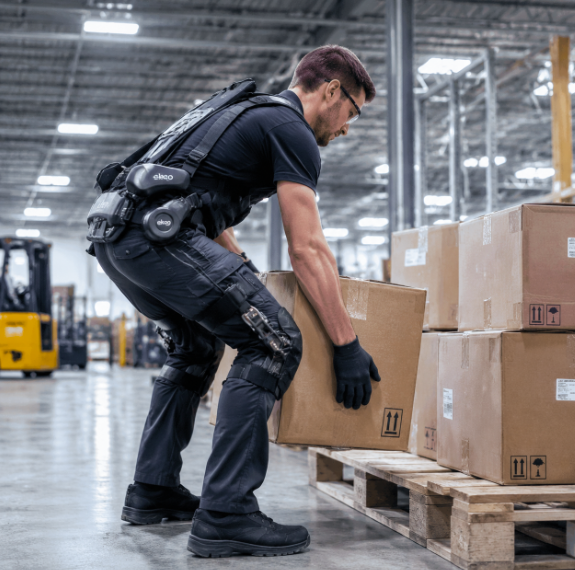
An industrial exoskeleton is a wearable mechanical structure (typically powered by batteries and actuators) that augments human strength and endurance. Unlike science fiction depictions, modern exoskeletons don’t turn workers into superhumans. They accomplish something more practical: they reduce physical strain.
Two categories dominate industrial deployment:
Passive Exoskeletons (No Power)
Mechanical structures that redistribute weight and reduce muscle activation. A worker wearing a passive exoskeleton lifts the same weight but with less biomechanical strain on lower back, shoulders, and knees.
Example: A construction worker holding scaffolding overhead. Passive exoskeleton redirects weight through frame to hips and legs rather than shoulder muscles. Muscle activation drops 20-30%. Worker can sustain the position longer before fatigue.
Cost: $1,000-$3,000 per unit. No power requirement, minimal maintenance.
Active Exoskeletons (Powered)
Battery-powered systems with motors that actively assist movement. Motor torque adds to human muscle torque, reducing muscular effort required to perform the task.
Example: Warehouse worker lifting 20kg packages 200+ times per shift. Active exoskeleton motors assist the lift, reducing required human muscle effort. Worker completes shift with 40-50% less fatigue, lower injury risk.
Cost: $5,000-$15,000 per unit. Runtime 8-10 hours. Requires charging infrastructure, maintenance.
Most industrial deployments use powered exoskeletons because the injury reduction and productivity gains justify the cost.
Real Performance Data: What Actually Happens
Lower back injury reduction: 20-40% (most common industrial injury is lower back strain)
Shoulder and neck injury reduction: 15-30%
Worker fatigue over 8-hour shift: 30-50% reduction
Productivity impact: Neutral to +10% (workers not slowed down, sometimes faster)
Worker acceptance: 60-75% positive after training period
These numbers come from real deployments, not marketing materials. Companies tracking worker injury rates, workers’ compensation claims, and sick days see measurable improvement within the first six months of exoskeleton deployment.
Example from logistics: Major e-commerce warehouse deployed 100 active exoskeletons for package handling. First-year results: lower back injuries down from 8 per 1000 workers to 5 per 1000. Workers’ comp claims reduced $200K. Productivity unchanged. Worker turnover down 12% (workers cite reduced physical strain as reason for staying).
The ROI Calculation That Justifies Deployment
The financial case for exoskeletons in high-injury industries is straightforward:
| Cost Category | Annual Investment (100 workers) | Notes |
|---|---|---|
| Hardware | $800K-$1.5M | $8-15K per exoskeleton, replacement cycle every 3-5 years |
| Maintenance | $50-100K | Battery replacements, part repairs, calibration |
| Training | $20-40K | Initial + annual refresher training |
| Total Annual Cost | $870K-$1.64M | Amortized over 3-year deployment |
| BENEFITS (First Year) | ||
| Injury reduction | $300-500K | Fewer workers’ comp claims, medical costs, lost productivity |
| Turnover reduction | $150-300K | Lower recruiting and training costs; experienced workers stay |
| Productivity gains | $50-150K | Slight speed improvements in some roles; offset by training time |
| Total Year 1 Benefit | $500K-$950K | Breaks even or approaches breakeven in Year 1 |
The math works. In year 2 and beyond (hardware already purchased), benefit exceeds cost by $300-600K annually. Over a 3-5 year deployment cycle, exoskeletons pay for themselves and generate positive ROI.
This is why companies that do the math are deploying. It’s not altruism. It’s straightforward cost-benefit analysis.
Why Adoption Is Slower Than The Numbers Suggest
If exoskeletons pay for themselves within 12-24 months, why aren’t all high-injury industries deploying them at scale?
1. Supply Chain Constraints
Exoskeleton manufacturers cannot scale production fast enough to meet potential demand. Lead times are 12-20 weeks. A company wanting 500 units faces a 6-month wait before deployment can begin. Smaller manufacturers have even longer waits or cannot access units at all.
2. Training and Adoption Friction
Workers need training before they can deploy. Exoskeletons feel strange the first few weeks. Some workers reject them (about 25-40% initially resist). Managers need training on maintenance and troubleshooting. A company deploying 200 exoskeletons needs to budget for a rollout period of 2-3 months, not a weekend implementation.
3. Maintenance Complexity
Active exoskeletons require charging infrastructure, spare parts inventory, and technical staff for repairs. Some companies lack the infrastructure to support dozens of powered devices simultaneously.
4. Risk Aversion in Larger Organizations
Big companies are often conservative. They want proof of concept from other companies first. They want established vendors and references. Early adopters are typically mid-size companies or innovative leaders. By the time Fortune 500 companies deploy, early movers have 3+ years of competitive advantage locked in.
5. Worker Perception and Union Concerns
Some workers fear exoskeletons are precursors to workforce reduction (“if workers need help to keep up, maybe jobs disappear”). Union contracts sometimes require negotiation before deployment. These are adoption barriers, not technical barriers.
Real Deployments: Who’s Moving First
Early adopters are concentrated in specific industries:
- Logistics and e-commerce: Amazon, DHL, Fedex pilot programs underway. High injury rates justify cost. Turnover is expensive.
- Automotive manufacturing: Tier-1 suppliers deploying for repetitive assembly tasks (torque work, overhead placement). Injury reduction is measurable and valued.
- Heavy manufacturing: Foundries, steel mills deploying for back-injury prevention in high-strain tasks.
- Construction: Selective deployment on specific high-injury tasks (overhead work, repetitive lifting). Slower adoption than manufacturing but growing.
Geographic concentration: Japan and Germany are early adopters (strong robotics culture, aging workforce, high wage costs). North America is following. Europe is scaling. Adoption in Asia (outside Japan) is slower due to lower labor costs.
Technology Improvements Enabling Scale
Three breakthroughs made exoskeletons practical in the last 3 years:
Battery Improvements
Runtime increased from 4-6 hours to 8-10 hours. This is critical for full-shift deployment. Early systems required mid-shift charging. Modern systems run a full shift on one charge.
Weight Reduction
Exoskeletons are lighter (3-5kg vs 8-12kg three years ago). This matters for all-day wear. If you’re wearing an extra 10kg on your torso all day, that’s its own strain. Lighter systems reduce this burden.
User Interface Simplification
Early exoskeletons required complex calibration and user adjustment. Modern systems have simplified controls. Workers can put them on and go. Training time dropped from hours to minutes.
What Comes Next (2026-2030)
2026-2027: Supply chain improves. Lead times compress to 6-8 weeks. Mid-market companies begin deployments. Competitive pressure increases (if competitors have exoskeletons, you need them to compete on injury rates and worker retention).
2027-2028: Large companies move from pilot to full deployment. Labor market tightens. Worker retention becomes more important. Exoskeletons become differentiator for worker satisfaction.
2028-2030: Exoskeletons become baseline expectation in high-injury industries. Companies not deploying face pressure from workers, regulators, and customers. Industry standards emerge. Cost compression continues (competition increases).
Key Takeaways
- Powered exoskeletons reduce worker injuries by 20-40% and fatigue by 30-50%
- ROI breaks even within 12-24 months for high-injury industries
- Adoption is slower than ROI math suggests due to supply constraints, training friction, and organizational risk aversion
- Early adopters are mid-size companies in logistics, automotive, and heavy manufacturing
- Technology improvements (battery, weight, interface) made exoskeletons practical in last 3 years
- Competitive pressure will accelerate adoption through 2028-2030
- By 2030, exoskeletons will be expected in high-injury industries, not optional
The structural insight: exoskeletons are not about turning workers into superheroes. They’re about injury prevention and worker retention. Companies deploying now lock in competitive advantage while competitors deal with higher injury rates, turnover, and workers’ comp costs. This advantage compounds over years. By 2030, exoskeleton deployment will be a table-stakes competitive requirement in high-injury industries.