Dog Robots (Spot & others): Protective Apparel, Smart Covers & Materials
World-class apparel and materials engineered for quadruped robots — protection, thermal control, sensor compatibility and custom OEM/ODM solutions that transform machines into trusted teammates.
If you operate Spot, ANYbotics, Unitree or custom quadruped platforms — this page shows how to choose materials, what to test, and how RobotsWear ensures uptime, reliability and long-term performance.
On this page
Why Robotic Apparel for Dog Robots? Best Materials & Technologies Products & Use Cases Testing & Certification Integration & Mounting Savings & ROI Simulator Case Studies FAQ & HowTo Get a Quote / PrototypeWhy Robotic Apparel for Dog Robots?
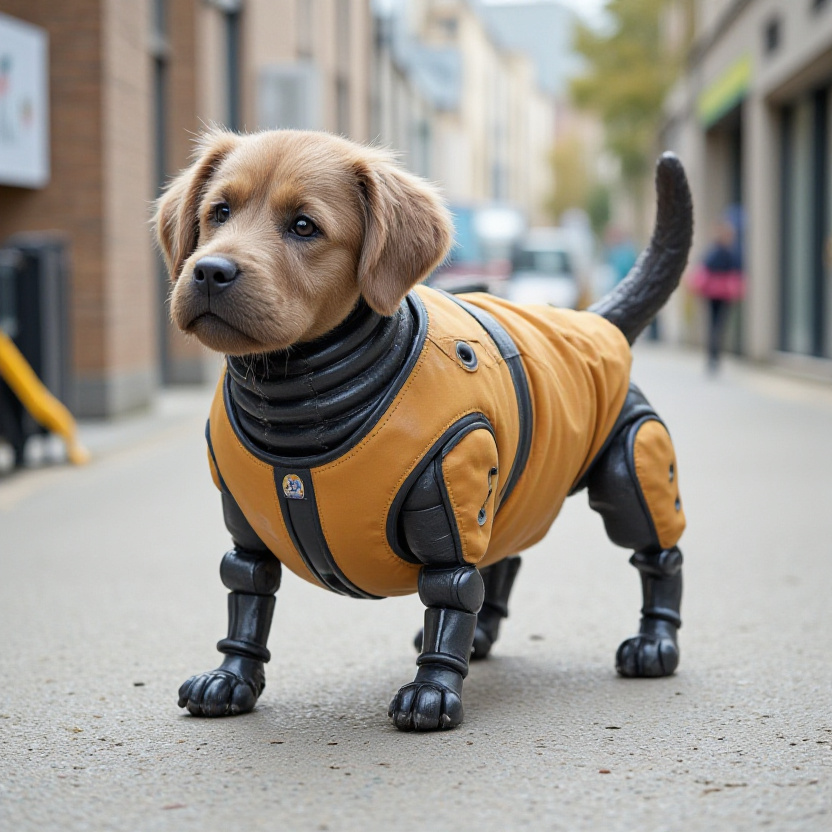
Robotic quadrupeds operate in complex, human-facing and industrial environments. Apparel for dog robots is not vanity — it’s functional engineering that reduces downtime, prevents damage, improves thermal management, protects sensors, and can be the difference between mission success and costly failure.
Primary reasons to outfit dog robots
- Impact & abrasion protection in rugged terrains
- Environmental sealing — water, dust, corrosives
- Thermal regulation for battery & electronics protection
- Sensor transparency and anti-reflective surfaces
- Branding / human-friendly aesthetics for public spaces
“The right textile system turns a robotic tool into a reliable team member — not a liability.” — Robotics Apparel Lead, Logistics Co.
Best Materials & Technologies for Dog Robots
We engineer systems that combine mechanical protection with electronic integration. Below are the materials we specify most often for quadrupeds.
| Material | Primary Benefit | When to use |
|---|---|---|
| Thermally conductive composite textile | Heat distribution & passive cooling | High-power applications, battery packs |
| Hydrophobic reinforced nylon | Water/dirt repellency, abrasion resistance | Outdoor operations, wet environments |
| Conductive textiles (silver/graphene) | Signal routing, sensor traces | Integrated sensor arrays, low-profile cabling |
| Stretch woven elastomer | Flex joints, strain relief | Leg joints, joints subject to repeated flex |
| PTFE-coated membranes | Breathability + waterproofing | Long sorties in variable climates |
LSI & technical keywords used on this page
smart textiles, e-textiles, conductive fabric, waterproof membranes, PTFE, hydrophobic coating, abrasion resistance, thermal management for robots, robotic protective covers, OEM robotic apparel
Products, Modules & Services — What RobotsWear Offers
Ready-made products
- Spot Protective Shell — modular hard-shell with quick-release mounting (Image placeholder: spot-shell.jpg)
- Leg Guards — abrasion-resistant panels for joint protection (Image placeholder: leg-guard.jpg)
- Thermal Vest — passive thermal control with phase-change inserts (Image placeholder: thermal-vest.jpg)
- Sensor-Flex Overlay — low-reflection overlay for LiDAR and cameras (Image placeholder: sensor-overlay.jpg)
Custom services
- OEM/ODM — bespoke fabrics and production runs for integrators
- Prototype & field testing — small-series prototyping & durability testing
- Materials consulting — selection & test plans for your environment
- Integration engineering — ensuring covers and apparel do not interfere with gait, payloads or sensors
Which product fits your use case?
- Inspection & mapping: lightweight overlay + LiDAR-transparent visor
- Industrial maintenance: reinforced hydrophobic shell + leg guards
- Public-facing applications: aesthetic outerwear + soft-touch surfaces to appear friendly
Integration & Mounting — Practical Engineering Notes
Small design choices avoid big failures. Below is our practical checklist used in every integration project.
- Quick-release points at non-critical structural locations
- Service panels for battery and electronics access
- Strain relief on any conductive textile traces
- Mass & balance testing after clothing installed
- EMI shielding around sensitive comms in high-interference sites
Mounting pattern example (high-level)
// Mount points (example)
1. Rear battery cover: 4x 6mm quick pins
2. Center spine: Velcro bridge for service hatch
3. Leg guards: clip-on at knee and ankle; flexible hinge at joint
4. Sensor visor: low-reflection strip + removable velcro
Testing, Validation & Certification
RobotsWear’s internal testing mirrors industry standards; we also tailor tests per customer mission profile.
Standard tests we run
- Abrasion & puncture resistance (EN ISO 12947 equivalent)
- Ingress Protection — water spray / splash tests
- Thermal cycling to replicate temperature swings
- EMC / EMI assessments for conductive layers
- Gait & mobility trials on different surfaces
How we validate on your platform
- Field requirements collection
- Prototype build
- Bench tests (lab)
- Pilot deployment (1–4 weeks)
- Iterate & scale
Interactive: Savings & ROI Simulator
Estimate how much downtime and maintenance costs you save by deploying protective apparel and optimized materials. This is a quick model — for exact ROI please contact us for a tailored analysis.
Assumption: protective apparel reduces incidents/downtime by 30%. For tailored simulations we provide a detailed Failure Mode Effectiveness Analysis (FMEA).
Client Case Studies & Visualized Journeys
Real projects—concise, visual, and outcome-focused.
Case: Industrial Inspection — “SiteGuard” Pilot
Challenge: Frequent abrasion and water ingress on inspection quadrupeds in refinery environments.
Solution: Hydrophobic reinforced shell + sealed service hatch + conductive trace channels for thermal sensors.
Outcome: 47% decrease in field repairs, full mission success rate increased by 35% in a 12-week pilot.
Image placeholder: case-siteguard-before.jpg / case-siteguard-after.jpg
Case: Public-facing Hospital Robot
Challenge: Robot used to deliver supplies in public hospital — needed friendly design and hygienic surfaces.
Solution: Soft antimicrobial outer layer, removable washable covers, anti-slip pads on feet.
Outcome: Positive patient sentiment, reduced contamination incidents, improved uptime.
Image placeholder: case-hospital-robot.jpg
- Discovery & mission mapping (week 0)
- Prototype design & materials selection (weeks 1–3)
- Lab & field validation (weeks 4–8)
- Pilot & iteration (weeks 9–12)
- Scaled rollout (post-week 12)
Checklist: What to validate before ordering
- Compatibility with mounting points
- Sensor occlusion test (camera and LiDAR)
- Mobility & gait testing on inclines and stairs
- Water garden test or IP spray test
- Ease of cleaning & serviceability
Top 6 mistakes we fix for clients
- Designing without service panels — causes long field service time
- Overweight apparel that shifts center of gravity
- Using non-breathable insulation causing thermal runaway
- Obscuring WiFi/antenna areas with conductive layers
- Incorrect fixation leading to tearing at the joints
- Not validating adhesives in high-humidity environments
Mini Quiz: Which material is right for your mission?
Answer 3 quick questions — we provide a recommended starting kit.
Resources & Further Reading
- RobotsWear R&D Hub — in-depth articles and test reports
- Boston Dynamics — Spot platform (manufacturer)
- Unitree — commercial quadrupeds
- Shop — pre-orders and limited concepts
FAQ
RobotsWear designs overlays with sensor transparency in mind. For cameras and LiDAR we use anti-reflective, low-diffuse materials and ensure no occlusion of FOV. For delicate sensors we use removable service flaps and trimmed apertures to preserve fidelity.
We specify abrasion resistance values and run cycle tests. Most field-grade overlays are rated for tens of thousands of abrasion cycles; we publish test reports on request for pilot projects.
Yes. We specialize in prototype & small-batch production. Typical lead times: 2–6 weeks for prototype, 4–12 weeks for pilot batch depending on components.
How to order: Quick Guide
Follow these steps to get a prototype or place a custom order.
- Request a prototype — share mission profile & current robot model.
- Approve design & materials — we provide CAD overlays and mockups (Image placeholder: overlay-cad.jpg).
- Field test & iterate — we support on-site evaluation.
- Scale manufacture — production handover and QC checks.
Ready to protect your fleet? Let’s build it together.
Whether you operate a fleet of 2 or 200 units, RobotsWear provides tailored solutions: from test samples to full OEM runs.
Summary — Key Takeaways
- Robotic apparel is functional engineering — it reduces downtime and protects sensors.
- Material choice must match environment, sensor stack and mobility constraints.
- RobotsWear provides prototype → pilot → scale workflow and supports OEM/ODM.