
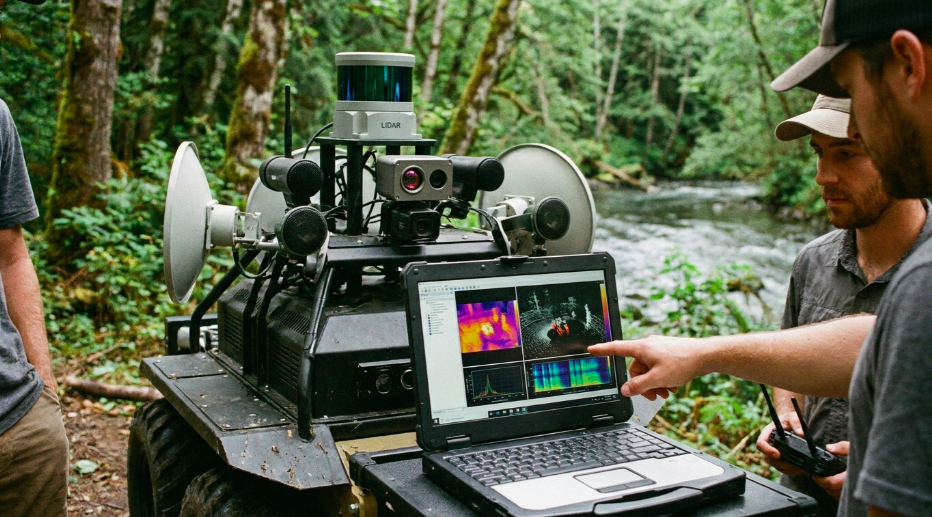
AI-Powered Multimodal Sensors: How Real-Time Signal Fusion Is Reshaping Autonomous Systems and Industrial Intelligence
Single-sensor systems are becoming obsolete. AI-powered multimodal sensors that combine video, thermal, acoustic, and lidar data in real time are now deployment-ready. Machine learning algorithms unravel overlapping signals, extracting meaning from conflicting inputs that no single sensor could provide. This shift from sensor isolation to sensor fusion is reshaping robotics, industrial automation, and environmental monitoring.
What Multimodal Sensor Fusion Actually Is
A multimodal sensor array is multiple sensing technologies (video, thermal, acoustic, lidar, pressure, vibration) mounted on a single platform or integrated into a unified measurement system. Each sensor captures different physical phenomena simultaneously. Machine learning algorithms fuse the data streams in real time, detecting patterns that emerge only when data types are combined.
Example from robotics: A robot navigating an industrial plant sees obstacles with lidar, detects thermal anomalies (bearing overheating) with thermal imaging, hears bearing noise with microphones, and identifies worker presence with video. No single sensor provides complete situational awareness. Fused together, they create robust, redundant perception.
Example from environmental monitoring: Air quality measurement. A single particulate sensor measures 2.5-micron particles. But what caused them? A thermal sensor detects source heat (cooking, combustion, or industrial process). An acoustic sensor detects impact or vibration (grinding, welding). A video stream provides visual confirmation. Fused data answers not just “what is in the air” but “where did it come from?”
The fusion process: Raw sensor outputs are preprocessed into aligned time series. Machine learning models (typically neural networks or temporal fusion transformers) learn the joint distribution across sensor types. At deployment, incoming multimodal data is processed by the fused model, which outputs predictions or classifications that reflect all available information simultaneously. When one sensor is occluded or fails, the remaining sensors degrade gracefully rather than causing complete system failure.
Why Multimodal Fusion Is Ready Now (After Decades of “Soon”)
Multimodal sensor fusion has been theoretically possible for 20+ years. Three breakthroughs made it practical:
1. Fusion Algorithms Matured
Early approaches tried to combine sensors at the decision level — each sensor made a prediction, then a voting system chose the result. This was inefficient and fragile.
Modern approaches fuse at the raw data level. Transformer architectures and multi-head attention mechanisms excel at learning which combinations of sensor inputs matter for specific predictions. The complexity that made fusion impractical in 2010 became tractable with GPUs and modern ML frameworks. Algorithms stopped being research topics and became implemented tools.
2. Edge Computing Handles Processing Locally
Cloud-based fusion required transmitting raw sensor data to remote servers. High bandwidth, high latency, vulnerability to network failure.
Edge AI (running ML models on local hardware) changed this. Modern edge devices (NVIDIA Jetson, Qualcomm AI Engine, others) process fused multimodal data at 10-30 frames per second locally. Latency dropped from 500ms (cloud round trip) to 30-50ms (local processing). This latency drop is critical for real-time applications like robotics and autonomous vehicles.
3. Power Consumption Dropped 60% in Three Years
Early multimodal sensor arrays consumed 50-150 watts just for sensor electronics and processing. Battery-powered robots could run for 2-3 hours before recharging.
Modern sensor integration and edge processors reduced power consumption to 20-40 watts for equivalent capability. Battery runtimes extended to 6-8 hours. This matters because deployment-grade systems need to operate for full work shifts without recharging.
Real-World Deployment Categories
| Industry | Application | Sensor Combination | Key Insight |
|---|---|---|---|
| Manufacturing | Predictive maintenance | Thermal + vibration + acoustic | Bearing failure detection 48-72 hours early |
| Robotics | Autonomous navigation | Lidar + thermal + video + acoustic | Robust path planning in dynamic environments |
| Environmental | Air quality monitoring | Particulate + thermal + acoustic + video | Pollution source identification and tracking |
| Healthcare | Patient monitoring | Thermal + infrared + acoustic + motion | Fall detection and respiratory monitoring |
| Security | Threat detection | Thermal + acoustic + motion + video | False alarm reduction, human activity classification |
The Competitive Advantage This Creates
Companies that architect multimodal sensor fusion now gain several advantages:
Sensor Diversity = Redundancy
Single-sensor systems fail when that sensor fails. Multimodal systems degrade gracefully. One sensor occlusion or failure reduces accuracy but doesn’t eliminate it. For mission-critical applications (autonomous vehicles, medical devices, industrial safety), this redundancy translates directly to uptime and liability reduction.
Conflicting Data Reveals Edge Cases
When video says “person approaching” but thermal says “no heat source,” that’s a potential false alarm. Or a hallucination in the video model. Multimodal fusion with attention mechanisms learns which sensor conflicts indicate which failure modes. This dramatically reduces false positives compared to single-sensor approaches.
Domain-Specific Models Train Faster
Generic models trained on broad datasets are expensive to train. But companies with multimodal sensor data from their specific domain (manufacturing floor, warehouse, hospital) can fine-tune fusion models rapidly. A company with six months of multimodal data can train models that outperform generic competitors within weeks.
Technical Barriers Remaining (And Being Solved)
Data Alignment
Sensors run at different framerates. Video at 30fps, thermal at 60hz, lidar at 10hz, acoustic at 48khz. Aligning these into coherent time series requires careful synchronization. Solutions: hardware synchronization (NTP between sensors), software resampling, and temporal padding. This is solved but requires engineering discipline.
Annotation Cost
Training multimodal models requires labeled data where all sensors are labeled simultaneously. This is expensive compared to single-sensor annotation. Solutions: transfer learning from single-sensor models, semi-supervised learning with unlabeled multimodal data, and synthetic data generation. These are reducing annotation cost but not eliminating it.
Model Interpretability
When a fusion model makes a decision, which sensor inputs drove it? Attention mechanisms help visualize this, but full interpretability remains challenging. Solutions: attention visualization, SHAP values applied to multimodal inputs, and deliberately interpretable architectures. This is an active research area with practical solutions emerging.
What’s Next (2026-2030)
2026-2027: Multimodal sensor deployment accelerates in robotics, manufacturing, and autonomous vehicles. Companies that shipped fusion systems early have competitive data advantages.
2027-2028: Standard sensor interfaces emerge (common APIs for lidar, thermal, acoustic, etc.). This reduces development cost and accelerates adoption.
2028-2030: Multimodal sensors become standard components rather than exotic research. Robotics platforms ship with integrated multimodal sensing by default. Industrial OEMs integrate fusion into standard equipment.
Key Takeaways
- Multimodal sensor fusion moves from research to deployment-ready systems
- Three breakthroughs enabled this: algorithm maturity, edge computing, and power efficiency
- Real-world applications span manufacturing, robotics, environmental monitoring, healthcare, and security
- Competitive advantage goes to companies building domain-specific fusion models with their own data
- Remaining barriers are engineering challenges, not fundamental research problems
- Standard sensor interfaces will accelerate adoption across industries
- Single-sensor systems become increasingly obsolete for mission-critical applications
The insight: multimodal sensor fusion is no longer “next year’s technology.” Companies architecting AI-powered fusion systems now will own the competitive advantage when this shift completes. Companies still designing single-sensor systems are building yesterday’s architecture.