
Electronic Skin Sensors: How Tactile AI Is Reshaping Prosthetics, Robotics, and Human-Machine Interfaces
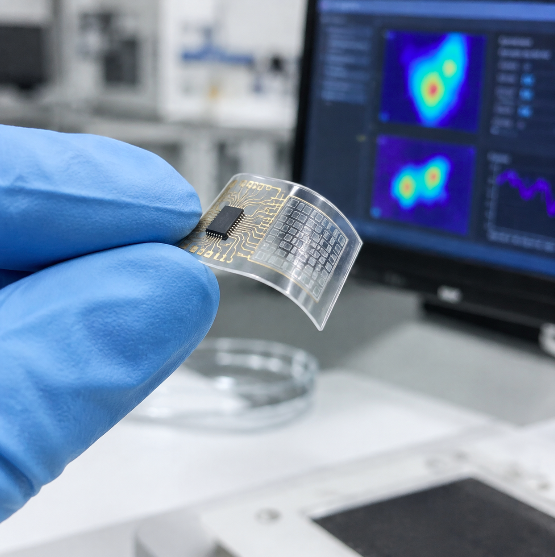
Electronic skin (e-skin) sensors have crossed from laboratory prototypes into practical deployment. These flexible sensor arrays detect touch, pressure, temperature, and nearby objects in real time. Prosthetics companies are integrating them to restore sensory feedback to amputees. Robotics companies are using them to give machines true tactile perception. The technology is no longer theoretical. It’s being embedded in products shipping in 2026. Understanding what e-skin sensors actually do, what barriers slowed deployment, and what applications are driving adoption now is essential for anyone tracking the future of human-machine interfaces.
What E-Skin Actually Is (And Isn’t)
Electronic skin is not a single technology. It’s a category of flexible sensor systems that mimic human skin’s sensory capabilities.
Human skin is extraordinarily complex. It detects pressure across a range of 0.1 to 100+ newtons. It distinguishes between light touch and deep pressure. It senses temperature (separate receptors for hot and cold). It detects texture through mechanoreceptors tuned to different frequencies of vibration. And it integrates all this information rapidly — you know immediately if something is sharp, hot, or smooth without conscious thought.
E-skin sensors attempt to replicate this complexity in a wearable or embeddable form. Most systems combine multiple sensing modalities:
- Pressure sensors: Capacitive or resistive elements that change electrical properties when deformed
- Temperature sensors: Thermistors or semiconductor sensors detecting thermal gradients
- Proximity sensors: Electromagnetic or optical sensors detecting nearby objects without contact
- Texture/vibration sensors: High-frequency accelerometers sensing surface roughness through tactile vibrations
All these sensors are integrated into a flexible substrate (often a textile or thin polymer) and connected to processing electronics that fuse the data in real time.
Why E-Skin Deployment Just Became Practical (After Decades of “Soon”)
E-skin research has existed since the early 2000s. The technology felt perpetually 5-10 years away. Three breakthroughs finally made deployment real:
1. Flexible Electronics Matured
Early e-skin was rigid. Sensors were mounted on hard circuit boards and then somehow made “flexible” by adding fabric around the edges. This was uncomfortable and unreliable.
Modern e-skin uses truly flexible electronics: sensors printed directly onto textile or thin polymer substrates using inkjet or screen printing. The entire sensor array flexes. No rigid components. Comfort improves dramatically.
2. Power Consumption Dropped 80% in Five Years
Continuous sensing across multiple modalities requires power. Early systems consumed 5-20 watts, requiring large batteries. Runtime was 2-4 hours.
Modern e-skin uses event-driven sensing (sensors activate only when detecting change, not continuously streaming data) and low-power processors. Power consumption dropped to 100-500mW. Battery runtime is now 12-24+ hours on small batteries.
3. AI Made Sensor Fusion Practical
With raw sensor data from five different modalities arriving simultaneously, extracting meaning required complex signal processing. Early approaches used hand-tuned algorithms. This was fragile and required recalibration for different applications.
Machine learning models trained on e-skin data can now fuse multimodal sensor inputs automatically. A neural network learns the joint distribution: when pressure spikes and temperature rises simultaneously while texture vibration increases, what does that mean? (Answer: something rough and hot is touching the sensor.) This learned fusion is far more robust than hand-tuned logic.
Real Applications: Where E-Skin Is Actually Deploying
Prosthetics and Sensory Restoration
This is the application with the most immediate human impact. Patients with limb amputations lose not just motor control but sensory feedback. A prosthetic arm moves but the user cannot feel what they are touching.
E-skin sensors embedded in a prosthetic hand or arm can restore this feedback. When the prosthetic touches an object, the sensor detects pressure and temperature. This information is transmitted to the user (either through vibration at the socket, or through direct nerve stimulation in cutting-edge research) giving the user real sensory feedback.
Clinical outcomes are dramatic. Prosthetic users with sensory feedback:
- Grasp objects with 40-50% less grip force (less fatigue)
- Feel surface textures and temperatures accurately
- Report dramatically improved sense of embodiment (the prosthetic feels like part of their body, not a tool)
- Regain ability to perform fine motor tasks (tying shoelaces, threading needles)
Companies deploying: LUKE Arm (bionic prosthetic with sensory feedback), Össur, Össur’s Empower Ankle, and research labs at MIT, Stanford, Carnegie Mellon.
Robotic Grippers with Tactile Sensitivity
Industrial robots have visual sensors (cameras, lidar) but no touch. A robot gripper grasps objects blindly — it closes until object pressure exceeds a threshold, then stops. This works for rigid objects but fails for delicate items (eggs, bread, fruit).
E-skin sensors give robot grippers true tactile feedback. The gripper can now feel pressure distribution across its fingers. It can detect when an object is slipping. It can sense texture and adjust grip strategy accordingly.
Practical applications:
- Fruit and vegetable picking: Robotically harvested crops were previously bruised because grippers applied too much force. E-skin enables gentle, pressure-controlled grasping.
- Egg handling: Fragile objects that require delicate touch. E-skin allows robots to adapt grip in real time.
- Quality control: Sensors detect surface defects, cracks, and texture variations that cameras miss.
- Assembly: Robots can now feel when parts are properly aligned and seated.
Companies deploying: ABB, KUKA, Universal Robots (all integrating e-skin into collaborative robots).
Wearable Health Monitoring
E-skin can monitor vital signs without dedicated sensors. Pressure sensors detect heartbeat and respiration. Temperature sensors track skin temperature. Proximity sensors detect falls or rapid movement patterns.
Applications: medical monitoring for elderly patients, athletes, or patients with specific conditions. E-skin patches could replace multiple discrete sensors with a single flexible system.
Clinical validation gap: Wearable health monitoring applications are still mostly in research or pilot programs. FDA approval for diagnostic use is pending for most e-skin health systems. This application will scale once regulatory pathways clear.
Technology Specifications That Matter
| Spec | 2020 Labs | 2026 Deployable | Why It Matters |
|---|---|---|---|
| Flexibility | Rigid components, poor comfort | Fully textile-based, conforms to skin | All-day wearability |
| Power consumption | 5-20W, 2-4 hour runtime | 100-500mW, 12-24+ hour runtime | Fits in small battery, all-day use |
| Pressure sensitivity | 10-100mN minimum | 1-10mN minimum | Detects light touch, not just heavy pressure |
| Response latency | 100-500ms | 10-50ms | Real-time tactile feedback feels natural |
| Temperature range | Limited, narrow range | -10°C to +50°C reliable | Works in real environments, not just labs |
Barriers That Still Exist
1. Manufacturing Scale
E-skin sensors are still mostly hand-made or produced in small batches. Mass manufacturing processes are not yet established. Production cost is high ($500-2000 per sensor array). This slows adoption for price-sensitive applications.
2. Signal Noise and Environmental Sensitivity
Real-world e-skin sensors are noisy. Environmental factors (temperature drift, electromagnetic interference, humidity) affect readings. Lab performance rarely translates directly to field performance. Companies have to do extensive field validation before deployment.
3. Integration and Data Transmission
Getting sensor data from e-skin to processing electronics to end-user interface requires careful engineering. Wireless transmission adds latency and power cost. Wired connections are cumbersome. Most deployed systems use a hybrid approach (local processing for low-latency feedback, wireless transmission for logging and analytics).
4. Regulatory Uncertainty for Medical Applications
E-skin for prosthetics is a medical device. FDA approval timelines are uncertain. Most prosthetics with e-skin feedback are still in clinical trials or recently cleared. This slows market adoption.
What Comes Next (2026-2030)
2026-2027: Prosthetic e-skin deployment scales as FDA approvals increase and insurance reimbursement improves. Industrial robotic applications expand beyond research pilots.
2027-2028: Manufacturing processes mature. Production costs drop 50-70%. E-skin becomes economically viable for more applications (wearable health, consumer robotics).
2028-2030: E-skin becomes standard in advanced prosthetics, collaborative robots, and specialized medical applications. Consumer-grade applications (smart gloves, VR haptics) begin to appear.
Key Takeaways
- E-skin sensors now detect touch, pressure, temperature, and proximity in real time
- Three breakthroughs enabled practical deployment: flexible electronics, low power, AI-driven sensor fusion
- Primary applications: prosthetics with sensory feedback, robotic grippers with tactile sensitivity, wearable health monitoring
- Clinical outcomes for prosthetics are strong (40-50% reduction in grip force, improved embodiment)
- Manufacturing scale, signal noise, and regulatory approval are remaining barriers
- By 2030, e-skin will be standard in advanced prosthetics and collaborative robots
The insight: e-skin sensors are no longer “next year’s technology.” They are embedding in prosthetics now and expanding into robotics over the next 2-3 years. Companies that build e-skin into their products first will have competitive advantage as the technology becomes expected rather than novel. The sensory revolution in human-machine interfaces is beginning now.