
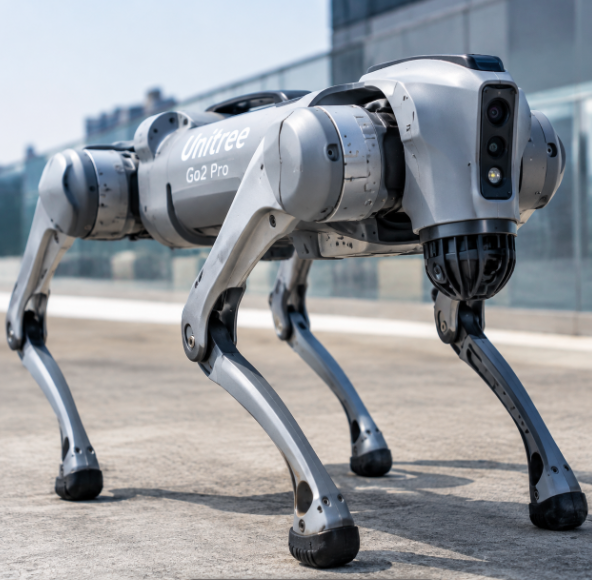
Unitree Go2 Pro Review: Impressive Quadruped, Unfinished Home Assistant
The Unitree Go2 Pro is a remarkable piece of engineering. Its locomotion is fluid, its hardware is solid, and its price undercuts almost every quadruped competitor. But a hands-on review reveals a clear gap: the Go2 Pro is an impressive robot that is not yet a capable home assistant. Its autonomy is limited, its task execution is narrow, and its usefulness in a real household remains aspirational. Understanding what the Go2 Pro does exceptionally well, where it falls short, and what this reveals about the state of consumer robotics is essential for anyone evaluating whether robot dogs are ready for the home.
What the Go2 Pro Gets Right
Locomotion and Agility
This is where the Go2 Pro shines. The quadruped moves fluidly across varied terrain. It climbs stairs, navigates uneven ground, recovers from pushes, and performs dynamic maneuvers (jumps, flips, sprints) with impressive stability. Unitree’s decades of quadruped control research show clearly here.
For anyone who has watched robot dogs on video, the lived experience matches the footage. The Go2 Pro is genuinely agile.
Hardware Build Quality
The mechanical construction is solid. Actuators are robust. The chassis handles bumps and minor impacts without drama. Sensors (lidar, cameras, IMU) are well-integrated.
Price-to-Capability Ratio
Compared to Boston Dynamics Spot or other research quadrupeds, the Go2 Pro is dramatically cheaper. This is Unitree’s core competitive advantage: delivering capable hardware at consumer-accessible pricing.
Where the Go2 Pro Falls Short
Autonomy Is Limited
Despite the “autonomous” marketing, the Go2 Pro’s autonomy is narrow. It navigates from A to B in mapped environments. It follows people or avoids obstacles. It performs pre-programmed routines. But genuine task autonomy — “go figure out what needs doing and do it” — is absent.
For a home assistant, this is the critical gap. A useful home robot would need to identify a task (dishes need washing, floor needs cleaning, item needs fetching), plan a solution, execute, and verify. The Go2 Pro does none of this without significant human input.
Task Execution Is Narrow
The Go2 Pro does not have manipulators. It cannot grasp, carry, or manipulate objects. It can walk around and observe, but it cannot actually perform physical household tasks.
What the Go2 Pro can do: navigate, follow, patrol, record video, perform tricks, inspect environments
What it cannot do: grasp objects, carry items, clean, cook, fetch, or perform any manipulation task
Software and Assistant Functions Are Unfinished
The “assistant” capabilities are limited. Voice interaction exists but is basic. Task planning is minimal. Integration with smart home systems is possible but requires technical setup and is not polished.
Battery and Practical Endurance
Runtime is limited (roughly 1-2 hours depending on activity). Recharging takes time. For a device meant to be a household companion, endurance is a real constraint.
The Fundamental Question: What Is a Robot Dog For?
The Go2 Pro exposes a category problem. Robot dogs are excellent at locomotion. They are poor at manipulation. But most “helpful” household tasks require manipulation (fetching, cleaning, carrying).
So what is a quadruped actually for? Legitimate uses:
- Inspection: Patrolling industrial sites, checking infrastructure, monitoring environments
- Security: Perimeter patrol, anomaly detection
- Research: Locomotion research, AI development platforms
- Entertainment: Performance, education, novelty
These are real, valuable applications. But they are not “home assistant” applications. Marketing the Go2 Pro as a home assistant sets expectations the hardware cannot meet.
What This Reveals About Consumer Robotics
1. Hardware Is Ahead of Software
Locomotion — the hard mechanical problem — is largely solved. Manipulation and autonomy — the hard software problems — are not. This is the reverse of the early computing era (where software outpaced hardware) and explains consumer robotics’ slow adoption.
2. Manipulation Is the Missing Piece
A robot that cannot pick things up cannot do household work. Until quadrupeds gain reliable manipulators and the AI to use them, “home assistant” quadrupeds remain conceptual.
3. Price Is No Longer the Barrier
The Go2 Pro is affordable. Cost is no longer preventing household robotics. Capability is. This shifts the constraint from economics to technology.
Comparison: Go2 Pro vs. Alternative Form Factors
| Form Factor | Locomotion | Manipulation | Home Assistant Potential |
|---|---|---|---|
| Quadruped (Go2 Pro) | Excellent | None | Low (no manipulation) |
| Humanoid | Good (improving) | Emerging (2 hands) | Medium (future potential) |
| Wheeled arm robot | Limited (flat floors) | Good (single arm) | Medium (narrow tasks) |
| Specialized (vacuum, etc.) | Optimized for task | Task-specific | High (for one task) |
The table makes the trade-off clear. Quadrupeds win on locomotion and lose on manipulation. Humanoids balance both but are immature. Specialized robots win by focusing on one task.
Who Should Buy the Go2 Pro
- Researchers: An affordable, capable quadruped platform for locomotion and AI research
- Hobbyists and enthusiasts: A remarkable robot for learning and experimentation
- Industrial operators: For inspection and patrol tasks (with appropriate integration)
- Educators: To teach robotics, control theory, and AI
Who should not buy it expecting a home assistant: anyone who wants a robot to actually do household chores. The Go2 Pro cannot do that.
What Comes Next
2026-2027: Quadruped locomotion improves further. Manipulation research advances. Prices continue to fall.
2027-2028: Quadrupeds with manipulator arms begin to appear (some already exist as research platforms). Autonomy improves with better AI.
2028-2030: The question of whether quadrupeds or humanoids or specialized robots win the “home assistant” category becomes clearer. Current evidence favors specialization + humanoids over quadrupeds for manipulation-heavy tasks.
Key Takeaways
- Unitree Go2 Pro has excellent locomotion and solid hardware at accessible pricing
- Its autonomy is limited and it lacks manipulation capability entirely
- It cannot perform household tasks requiring grasping or carrying
- Marketing it as a home assistant sets expectations the hardware cannot meet
- Hardware (locomotion) is ahead of software (autonomy and manipulation)
- Price is no longer the barrier to household robotics; capability is
- Quadrupeds excel at inspection, security, research, and entertainment — not home assistance
The structural insight: the Go2 Pro is a genuinely impressive machine that reveals the state of consumer robotics. Locomotion is solved; manipulation and autonomy are not. Until quadrupeds gain reliable manipulation, the “home assistant” framing remains aspirational. Buy it as a research platform or enthusiast robot — not as a household helper.