
Top AI Humanoid Robot Companies 2026: The Infrastructure Battle Reshaping Industrial Labor
Humanoid robots are no longer theoretical. Companies are deploying bipedal robots into warehouses, factories, and logistics operations today. The competitive race is accelerating. Understanding who the key players are, what their strategies differ on, and why humanoid form factor matters despite being mechanically inefficient is essential for anyone tracking the future of industrial labor and robotics deployment.
Why Humanoid Form Factor Despite Mechanical Inefficiency
First question: why build humanoid robots at all? Wheeled robots are faster. Multi-legged robots are more stable. Humanoid bipedal locomotion is mechanically complex and energy-inefficient compared to alternatives.
The answer is infrastructure compatibility. Human environments are designed for humans:
- Stairs: Warehouses have stairs. Wheeled robots cannot climb them. Humanoid robots can.
- Doorways and human-scale spaces: Human workstations, bathrooms, standard doors. Humanoid robots fit without modification.
- Existing tools and interfaces: Forklifts, buttons, handles, levers. All designed for human hand and reach. Humanoid robots use the same tools without retrofitting.
- Social acceptance: Humans are more comfortable around anthropomorphic robots than insectoid multi-legged platforms. This matters for workplace adoption.
The strategic insight: retrofitting human infrastructure to accommodate specialized robots is expensive. Deploying humanoid robots that work in existing human infrastructure is cheaper. This economics advantage compensates for mechanical inefficiency.
The Key Players and Their Strategies
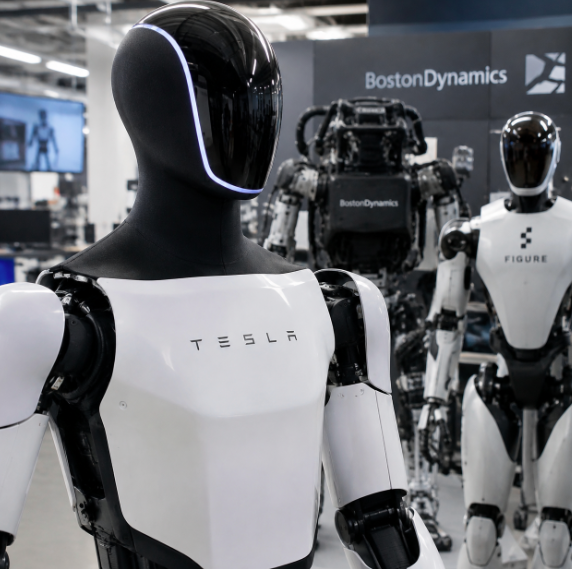
Tesla Optimus: Volume Play
Strategy: Low cost, high volume, Tesla ecosystem integration.
Current state: Tesla has deployed limited Optimus units internally in factories. Target: $25,000 per unit at scale (compared to $150,000-$500,000 for competitors).
Competitive positioning: Tesla is betting on manufacturing scale and vertical integration. Tesla owns battery production, motor design, and manufacturing capacity. This allows cost compression that pure robotics companies cannot match.
Timeline: Optimus deployment to third-party customers expected late 2026. Manufacturing scale ramping through 2027-2028.
Risk: Cost-driven quality compromises. Optimus performing worse than premium competitors could undermine deployment. Also, Tesla’s battery supply is already stretched for vehicles; robotics compete for production capacity.
Boston Dynamics: Premium and Specialized
Strategy: High performance, specialized tasks, not volume play.
Current state: Atlas (humanoid) and Spot (quadruped) deployed in specialized industrial environments. Premium pricing ($150K-$500K+). Limited deployment volume but high capability.
Competitive positioning: Boston Dynamics focuses on hard tasks requiring dexterity and precision: nuclear waste cleanup, surgery-adjacent tasks, complex manipulation. They are not competing on cost; they are competing on capability.
Timeline: Continued development of Atlas. New humanoid prototypes in testing.
Advantage: Perception as technology leader. Government and enterprise customers willing to pay premium for proven capability.
Figure AI: Warehouse and Logistics Focus
Strategy: Purpose-built for warehouse and logistics tasks.
Current state: Figure A1 humanoid robot deployed in logistics facilities for piece picking and box handling. Mid-range pricing ($150K-$200K per unit estimated). Focused deployment rather than broad market.
Competitive positioning: Figure is narrower in scope than Tesla (laser focus on logistics) but broader in capability than Boston Dynamics (volume over specialization). Backed by OpenAI and other investors.
Timeline: Expansion to more logistics customers through 2026-2027.
Advantage: Deep focus on specific high-value use case. Understanding logistics operations better than generalists.
Chinese Competitors: Unitree, others
Strategy: Cost and iteration speed.
Current state: Unitree H1 and Go2 (quadruped) deployed in Chinese factories. Aggressive pricing ($30K-$80K range). Rapid iteration cycles.
Competitive positioning: Chinese manufacturers leveraging lower labor costs, rapid prototyping, and integrated manufacturing supply chains to undercut Western pricing. Less polished software but acceptable performance for price.
Timeline: Expansion beyond China expected 2027-2028.
Risk to Western players: Cost advantage is structural. Hard to compete on price alone.
Traditional Industrial Robotics Makers: ABB, KUKA, Universal Robots
Strategy: Leverage existing industrial customer relationships.
Current state: Limited humanoid deployment. Mostly focused on traditional industrial arms and collaborative robots.
Competitive positioning: ABB and KUKA have customer relationships in manufacturing and logistics but are slower to innovate than pure robotics startups. Universal Robots is growing but still focused on collaborative arm markets.
Timeline: Humanoid offerings expected 2027-2028.
Risk: Incumbency advantage (existing customer relationships) is offset by organizational inertia. By the time they deploy humanoid robots, the market may already be shaped by Tesla, Boston Dynamics, Figure, and Chinese competitors.
Comparative Performance and Cost
| Company | Target Cost | Deployment Focus | Timeline | Competitive Advantage |
|---|---|---|---|---|
| Tesla Optimus | $25K (goal) | Manufacturing/logistics volume | Q4 2026 deployment | Cost, vertically integrated |
| Boston Dynamics | $200K-$500K | Specialized precision tasks | Ongoing development | Capability, brand |
| Figure AI | $150K-$200K | Warehouse/logistics | 2026-2027 expansion | Specialization, OpenAI backing |
| Unitree (China) | $30K-$80K | Factory deployment | 2027+ global | Cost, rapid iteration |
| ABB/KUKA | $150K-$200K | Industrial systems | 2027-2028 | Customer relationships |
Market Size and Adoption Drivers
Total addressable market: $100B+ by 2035
Humanoid robot deployments 2026: ~1,000-2,000 units globally
Projected deployments 2030: 50,000-100,000 units annually
CAGR 2026-2035: 40-50%
Growth is driven by:
- Labor shortage: Developed economies face worker shortages in manufacturing and logistics. Robots fill gaps.
- Cost convergence: As unit costs drop from $500K to $25-150K, ROI becomes compelling within 2-3 years.
- Performance improvements: AI advances in locomotion, manipulation, and decision-making make robots useful for broader tasks.
- Supply chain investment: Companies investing in automation infrastructure now lock in competitive advantage.
Deployment Reality: What’s Actually Working
Piece Picking and Box Handling
This is working. Robots with gripper systems can identify boxes, pick them, and place them on conveyor systems. Performance is improving. Early deployments show 20-30% productivity improvement once integration costs are amortized.
Repetitive Assembly Tasks
Working in controlled environments. Repeatable tasks with fixed components. Dexterity remains a bottleneck for complex assemblies, but point tasks are viable.
Safety and Collaborative Scenarios
Humanoid robots performing dangerous tasks (chemical handling, extreme temperatures) reduce human exposure. This is a strong use case even if productivity gains are modest.
What’s Still Failing
- Unstructured environments: Cluttered spaces with variable layouts challenge robot perception and planning.
- Fine dexterity: Tasks requiring fingers and sensitive touch remain difficult.
- Dynamic human interaction: Robots working alongside humans in unpredictable scenarios still have coordination challenges.
What Comes Next (2026-2030)
Q4 2026-Q1 2027: Tesla Optimus deployment accelerates. Early customers (logistics companies, manufacturers) provide real-world performance data. Chinese competitors expand beyond China.
2027-2028: Cost compression continues. Tesla approaching $25K target. Chinese models dropping to $15-30K range. Boston Dynamics releases new specialized systems. Traditional makers (ABB, KUKA) announce humanoid products but with delayed deployment.
2028-2029: Market bifurcation solidifies. Premium segment (Boston Dynamics, specialized players) commands $150K-$500K for exceptional capability. Cost segment (Tesla, Chinese) owns $25K-$80K volume market. Middle tier (Figure, generalists) caught between.
2029-2030: Humanoid robots become expected infrastructure in major logistics hubs, manufacturing plants, and warehouses in developed economies. Supply chain expertise and deployment integration become critical competitive differentiator.
Key Takeaways
- Humanoid form factor matters because human infrastructure already exists; retrofitting is expensive
- Tesla is competing on cost and volume; Boston Dynamics on capability and specialization; Figure on logistics focus
- Chinese competitors (Unitree, others) have structural cost advantage and rapid iteration speed
- Market is splitting into premium/specialized segment and cost/volume segment
- Deployments are working for piece picking, box handling, and specialized dangerous tasks
- By 2030, humanoid robots will be standard infrastructure in major logistics and manufacturing operations
The structural insight: humanoid robotics is becoming an infrastructure race. Companies deploying first lock in supply chains, manufacturing expertise, and customer relationships. Geographic competition is intensifying (US/Western companies vs. Chinese competitors). The companies that scale production and deployment through 2027-2028 will own the market by 2030.