
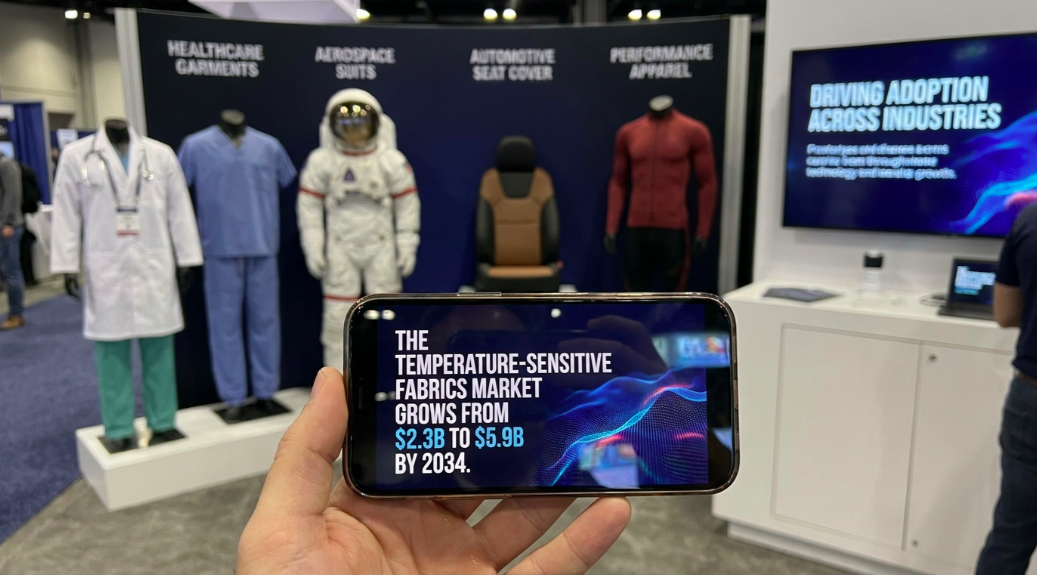
Temperature-Sensitive Fabrics: The $5.9 Billion Market Hiding in Plain Sight
Your jacket doesn’t know you’re hot. It just sits there. That’s the problem temperature-sensitive fabrics solve — and why the market is about to more than double. From $2.3 billion in 2023 to $5.9 billion by 2034, this is the quiet materials revolution nobody’s talking about.
The global market for temperature-sensitive fabrics is growing at 7.3% annually through 2034. That growth isn’t coming from one sector — it’s five industries converging simultaneously: healthcare, aerospace, automotive, apparel, and industrial. Each has a different reason for buying. Together, they’re reshaping what “fabric” means.
What Temperature-Sensitive Fabrics Actually Are
Temperature-sensitive fabrics are textiles engineered to physically respond to changes in heat, humidity, or perspiration. They’re not smart fabrics in the sensor-and-battery sense. They’re smart materials — chemistry that responds to the environment without electronics, power, or software.
Two main technology families drive the market:
Phase-Change Materials (PCMs)
PCMs absorb heat as they melt and release heat as they solidify — all within a narrow, engineered temperature window. When embedded in fabric, they act as a thermal buffer. Getting too warm? The PCM absorbs excess heat. Cooling down? It releases that stored energy back.
The result: a microclimate around the body that resists temperature swings without any active system.
How PCMs work in practice: A PCM capsule embedded in fabric is designed to transition (melt) at, say, 34°C — just above comfortable skin temperature. When body heat pushes past that threshold, the capsule absorbs the heat to complete the phase change. When temperature drops, the material solidifies and releases that stored heat. The wearer stays within a tighter thermal band automatically.
Shape-Memory Polymers and Responsive Structures
A second class of temperature-sensitive fabrics uses shape-memory polymers (SMPs) or moisture-responsive fibers that change their physical structure — porosity, stiffness, curvature — in response to temperature or humidity. When warm, the fabric opens its structure to allow airflow. When cold, it closes.
Unlike PCMs, which store and release energy, these fabrics regulate airflow and insulation passively by changing their geometry.
The Market Numbers That Matter
Market value 2023: $2.3 billion
Market value 2034: $5.9 billion
CAGR 2024–2034: 7.3%
Asia-Pacific share: growing to 42%+ (fastest regional growth)
Primary driver: Healthcare and high-performance apparel
7.3% compound annual growth is significant for a materials market. It’s faster than the overall textiles sector (2-3%) and comparable to specialty materials like advanced composites. This isn’t driven by hype — it’s driven by five industry sectors with legitimate procurement budgets.
Industry Breakdown: Who’s Buying and Why
| Sector | Key Application | Growth Driver | Stage |
|---|---|---|---|
| Healthcare | Patient monitoring garments, wound dressings, post-surgical wraps | Remote patient care, temperature-regulated wound healing | Scaling |
| Aerospace | Crew thermal management, passenger cabin comfort | Fuel efficiency (reduce HVAC load), crew comfort regulations | Established, expanding |
| Automotive | Seat upholstery, interior panels, EV cabin management | EV energy efficiency (reduce thermal load on battery) | Rapid growth |
| Apparel | Outdoor, sports, workwear, military | Performance differentiation, consumer demand for comfort | Maturing, premium shift |
| Industrial | Protective workwear in variable temperature environments | Worker safety regulations, liability reduction | Early-growth |
Healthcare: The Fastest-Scaling Sector
Healthcare is where temperature-sensitive fabrics are seeing the sharpest demand increase. Three specific applications are driving procurement:
- Wearable monitoring garments: Fabrics that maintain stable skin temperature improve the reliability of biometric sensors (heart rate, SpO2, ECG). Thermal stability reduces noise in monitoring data.
- Wound care textiles: PCM-integrated dressings maintain an optimal healing temperature range at the wound surface. Temperature-regulated healing demonstrably reduces infection risk and speeds closure.
- Post-surgical and rehabilitation: Temperature regulation reduces swelling and discomfort in post-operative settings, enabling earlier patient mobility.
The healthcare sector’s adoption is also being driven by the shift toward remote patient monitoring. Devices that work outside clinical settings need to work in variable temperature environments — which means the textiles they’re embedded in need to maintain stable conditions.
Automotive: The Surprise Growth Driver
The EV transition is directly accelerating temperature-sensitive fabric adoption in automotive. Here’s the mechanism:
Electric vehicles have a fundamental thermal problem: lithium-ion batteries lose efficiency and range in temperature extremes. Cabin heating and cooling to maintain passenger comfort draws significantly from the battery — reducing range. Any reduction in cabin thermal load extends range.
Temperature-sensitive seat fabrics and interior surfaces that passively regulate the thermal environment around passengers reduce HVAC demand. Less HVAC demand means more range. That’s a direct economic value proposition for automotive OEMs.
This is why major automotive suppliers are building PCM integration into their next-generation interior roadmaps. The material cost is justified by the range improvement story.
Aerospace: Established and Expanding
Aerospace adoption of temperature-sensitive materials is more mature than other sectors — aviation has been using PCM-based thermal management in non-textile applications for decades. The expansion now is specifically into crew and passenger-facing textiles.
Aircraft cabins have extreme thermal challenges: high altitude, variable solar load, tightly packed passengers generating body heat, limited HVAC capacity. Temperature-sensitive seat and wall fabrics reduce the active thermal management load, which translates directly to fuel savings.
Why Asia-Pacific Leads Growth
The fastest growth is in Asia-Pacific — projected to reach 42%+ of global market share by 2034. Three factors explain this:
- Manufacturing concentration: Asia hosts the majority of global textile manufacturing. Integration of advanced materials into production happens where manufacturing is.
- Automotive market size: China is the world’s largest EV market by volume. EV interior materials procurement is enormous.
- Healthcare investment: Aging populations in Japan, South Korea, and China are driving significant investment in healthcare-adjacent textile applications.
European and North American markets are growing but more slowly — they’re already more mature in aerospace applications and face higher price sensitivity in apparel.
The Key Competitive Players
The market is fragmented at the materials innovation level but consolidating at the integration level. Major players include:
- Outlast Technologies: PCM technology pioneers, aerospace heritage, licensing model
- Microtek Laboratories: Microencapsulation specialists, OEM supply focus
- Cryopak / Phase Change Energy Solutions: Industrial and logistics applications
- Invista / Koch Industries: Large-scale fiber production with smart-material integration
- Teijin: Asian manufacturing scale, automotive and aerospace supply chains
The competitive dynamic: materials innovators (PCM technology, SMP synthesis) are licensing to large textile manufacturers who have the scale and supply chain relationships. Vertical integration is limited — most players specialize in either materials science or manufacturing, not both.
What’s Holding the Market Back
Despite strong growth, three barriers are slowing faster adoption:
1. Unit Cost Premium
Temperature-sensitive fabrics carry a 20-50% cost premium over conventional alternatives at current production volumes. For healthcare and aerospace, this is acceptable — the functional benefit justifies it. For mass-market apparel, it limits adoption to premium tiers. As volumes scale, this premium will compress, but it remains the primary barrier in consumer markets today.
2. Durability Under Repeated Processing
PCM microcapsules can rupture under repeated washing cycles or mechanical stress. Industrial laundry in healthcare settings is particularly challenging. Current formulations handle 50-100 wash cycles reliably; extending this to 200+ cycles (healthcare standard) requires material engineering work still in progress.
3. Standardization Gaps
There’s no universal test standard for temperature-sensitive fabric performance. Healthcare buyers can’t easily compare specifications across suppliers. Aerospace OEMs conduct their own qualification testing. This lack of standardization increases procurement cost and slows specification into new applications.
What the Market Looks Like in 2030 vs. 2034
2030 midpoint: Healthcare and automotive dominate procurement. PCM materials are approaching cost parity with premium conventional textiles. Durability issues are largely resolved. Asian manufacturers are supplying 55%+ of global volume.
2034 endpoint: $5.9B market. EV adoption has made temperature-sensitive automotive interiors near-standard in premium and mid-tier vehicles. Healthcare adoption is widespread in developed markets. Shape-memory polymers begin scaling as a second major technology family alongside PCMs. Apparel enters mass-market pricing as volumes allow cost compression.
The Insight Most Manufacturers Miss
Temperature-sensitive fabrics are not “smart clothing.” That framing leads procurement teams to compare them to electronic wearables — which require charging, maintenance, and software updates.
The correct framing is passive materials engineering. No electronics. No battery. No connectivity. Just chemistry that responds to physics. This makes temperature-sensitive fabrics fundamentally more durable, scalable, and maintainable than active electronic alternatives.
That’s why the market is growing across sectors that couldn’t easily adopt electronic textiles: automotive interiors, industrial workwear, standard healthcare settings. Passive materials go places active electronics can’t.
Key Takeaways
- Market doubles from $2.3B (2023) to $5.9B (2034) at 7.3% CAGR
- Five sectors driving growth simultaneously: healthcare, aerospace, automotive, apparel, industrial
- Asia-Pacific leads growth due to EV market size and manufacturing concentration
- PCMs and shape-memory polymers are the two main technology families
- Passive materials engineering — not electronics — is the core value proposition
- Cost premium, wash durability, and standardization gaps are the remaining barriers
- EV adoption is a structural accelerant through the automotive channel
- Healthcare demand is driven by remote monitoring and temperature-regulated wound care