
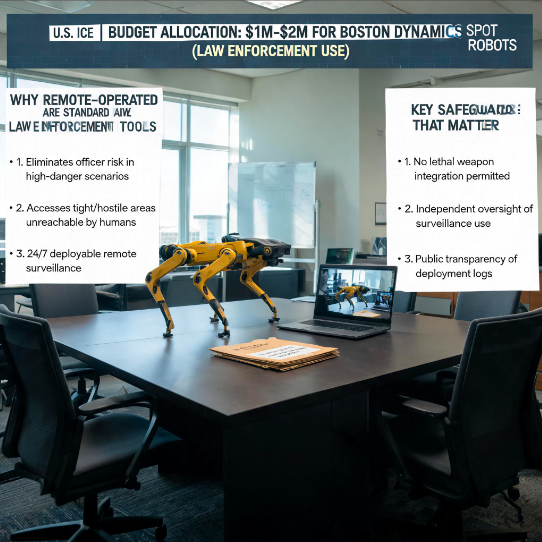
Robot Dogs in Law Enforcement: Why ICE’s Boston Dynamics Procurement Signals a Structural Shift in Government Operations
When a government agency moves from “evaluating pilot programs” to “allocating operational budget,” something structural has shifted. ICE’s $1-2 million procurement of Boston Dynamics robot dogs isn’t experimental. It’s real procurement for real deployment in high-risk operations. This is the moment autonomous platforms transition from research curiosity to law enforcement infrastructure.
What Exactly Is Being Deployed
Boston Dynamics Spot is a quadruped robotic platform. Weighs 70 pounds. Runs for approximately 2.5 hours on battery. Navigates stairs, rough terrain, and unstructured environments. Equipped with cameras (visible and thermal), microphones, and lidar sensors. Can be operated remotely via video feed or semi-autonomously with onboard navigation.
For ICE, the operating profile is reconnaissance before human entry. Send the robot into an unknown or dangerous space. Video feeds inform officers about threats, occupancy, structural hazards, or chemical contamination before human personnel commit to entry. This reduces officer exposure in scenarios with highest injury or fatality risk.
Why This Procurement Matters (Beyond The Headline)
Three things signal structural change:
1. From pilot to operational procurement: Pilots are experiments. Procurement is infrastructure commitment. ICE allocated budget, which means they evaluated deployment scenarios, determined the platform solves real problems, and decided it’s worth operational integration. That’s not theoretical anymore.
2. Cost-benefit analysis passed: $1-2 million for a small fleet of robots sounds expensive until you quantify what agencies are buying: officer safety improvement, reduced deployment risk, better situational awareness before tactical commitment. Agencies don’t spend operational budget on things that don’t solve real problems.
3. Other agencies will follow: When one major federal agency validates a technology, others take notice. FBI, DEA, border patrol, local SWAT teams — agencies that currently operate under higher risk conditions will evaluate similar deployments. Market precedent is being set now.
What The Robot Actually Does (And Doesn’t)
Critical distinction: Spot is a remote-operated reconnaissance platform, not an autonomous enforcement tool.
What it does: Gathers visual and sensor data from hazardous locations before human entry. Provides real-time video feed to operators. Navigates terrain too dangerous for immediate human deployment. Documents scenes for evidence. Operates without human personnel at immediate risk.
What it doesn’t do: Make tactical decisions independently. Apprehend or restrain suspects. Use force. Determine threat level autonomously. The operator sees what the robot sees and makes all decisions.
This matters for the safeguards conversation. Spot is not making lethal decisions independently. It’s an information-gathering tool. The risk profile is entirely different from autonomous enforcement.
Real Operational Scenarios Where This Applies
- Building entry (unknown occupancy): Robot enters first. Visual assessment informs tactical planning before personnel deployment. Reduces ambush risk.
- Chemical or biological hazard assessment: Robot operates in contaminated environment. Operators assess conditions from safe distance. Humans deploy only after hazard level is known.
- Structural instability: Building damage, floor collapse risk, structural compromises. Robot navigates to assess before personnel entry.
- Evidence documentation: Robotic video provides recorded chain-of-custody documentation. Consistent camera angles. Repeatable documentation.
- Thermal reconnaissance: Night operations, heat signatures, occupancy detection. Thermal camera informs deployment strategy.
These are recurring operational scenarios that have resulted in officer injuries or deaths when approached without proper reconnaissance. The robot solves a real problem.
The Safeguards Question (What Actually Matters)
The critical conversation is NOT “should law enforcement use robots?” The answer to that is already being made by procurement offices with budget authority. The conversation that needs to happen NOW is “how do we establish oversight WHILE deployment proceeds?”
Five safeguards questions matter:
- Operational authority: Who decides when the robot is deployed? What threshold of risk justifies deployment? What documentation tracks deployment and outcomes?
- Accountability: If deployment results in injury or death (to officers or civilians), what accountability exists? Who is responsible for operator decisions?
- Escalation risk: Does robot presence escalate situations? Do suspects behave differently knowing a robot is present? What data informs this understanding?
- Public transparency: Should agencies disclose frequency of robot deployment? Outcomes? Circumstances? What information should be public?
- Capability boundaries: What are robots explicitly prohibited from doing? Are weapons systems off-limits? What about non-lethal options? How are these decisions made?
These questions don’t require blocking deployment. They require establishing oversight frameworks WHILE deployment happens. That’s the window that’s closing.
The Policy Lag Problem
Technology deployment timescale: 12-24 months (from procurement to operational deployment).
Policy development timescale: 24-60+ months (from proposal to regulation to implementation).
What happens in the gap: agencies deploy with minimal oversight, incident drives policy response, reactive regulation follows. The better path: establish oversight frameworks in parallel with deployment.
This window is narrow. ICE procurement is happening now. Policy discussions are just beginning. What gets established in the next 12-18 months becomes standard practice for years after.
Comparison to Other Deployments
This isn’t unprecedented. Agencies have used bomb disposal robots for 20+ years. Drones have been used by law enforcement for 10+ years. Robot dogs are evolution of this capability, not revolution.
The safeguards questions are the same ones that applied to bomb robots and drones: When is this tool deployed? Who makes the decision? What accountability exists? How is it overseen?
The difference: deployment timescale is faster now. Market for autonomous platforms is growing. Competing vendors are developing capabilities. The momentum is harder to slow down once it starts.
What Comes Next
Q4 2026 – Q1 2027: ICE deployment begins. Other agencies (FBI, DEA, local SWAT teams) request procurement approval or conduct evaluations.
Q1 – Q3 2027: Congressional hearings begin. Civil liberties groups raise concerns. Agencies defend operational value. Policy conversations accelerate.
Q3 2027 – Q2 2028: First incidents occur (robot malfunction, escalation, injury). Incident drives policy response. Regulations begin to form.
2028+: Mature regulatory framework (if we’re fortunate) or patchwork of inconsistent standards (if policy lags further).
Key Takeaways
- ICE procurement is real — moving from pilot to operational deployment
- Robot dogs are reconnaissance tools, not autonomous enforcement platforms
- Operational logic is sound — reduce officer exposure in high-risk scenarios
- Safeguards questions are critical and time-sensitive
- Policy lag is the structural problem, not the technology itself
- What gets established in next 12-18 months becomes standard practice for years
- Other agencies will follow ICE’s lead — market precedent is being set now
The insight: This isn’t a debate about whether autonomous platforms should exist in law enforcement. That decision is already being made through procurement. The only question is: what safeguards are established WHILE it’s happening? That window is now. Close it later and you’re dealing with entrenched practices and reactive policy instead of intentional oversight frameworks.